SUBJECT:
THE AMAZING TRUTH ABOUT CATHOLIC CONFESSION IN THE AGE OF PHYCHIATRIC MEDICINE
QUESTION:
DO CATHOLIC SACRAMENTAL CONFESSIONS AND PHYCHIATRIC THERAPY SESSIONS EQUATE?
DISCUSSION:
Jesus appeared to his disciples in a locked upper room forty days after His glorious resurrection. Apostle John’s Gospel (20: 20-23) restates Jesus’ very words: “Peace be with you. As the Father has sent me, so I send you.” And when he had said this, he breathed on them and said to them, “Receive the holy Spirit. Whose sins you forgive are forgiven and whose sins you retain are retained.” The Apostle John’ Gospel states: “If we confess our sins, he is faithful and just, and will forgive our sins and cleanse us from all unrighteousness” (John 1:9)
At that moment Christ created the Catholic Sacrament of Confession. Thereafter, each penitent who seeks reconciliation of sin through the priest confessor, acting in persona Christi (in the person of Christ), has their sins absolved – at that moment.
At this paper’s conclusion, in a note, find a brief timeline summary tracing how the early Church’s doctrine matured about the Sacrament of Confession. But first, this great article will explain the differences and similarities of the sacrament of Confession to a priest versus a psychiatric session with a medical doctor:
A publication of the Catholic Medical Association (UK), a registered charity, No. 1002347: Vol. 71(4) Nov. 2021, titled Confession and Mental Health best explains the dichotomy:
“When speaking of the priest’s contribution to mental health, one’s thoughts turn first to his function as confessor. Now, confession in the Catholic sense has a therapeutic value all its own, but it cannot be compared with any other therapeutic device since confession is a sacrament and therefore belongs to the supernatural order.
Those who look upon sacramental confession as just another psychotherapeutic device miss its meaning completely . . . although confession belongs to the supernatural order, it has psychotherapeutic aftereffects, for it not only rids the penitent of his sins but greatly contributes in most cases to his feelings of security by ridding him of his feelings of guilt.” [1]
The above quote is a neat summary of what follows. In his excellent booklet titled Confession: A Source of Enduring Grace, Father J de Mallmann writes about a doctor who tells a priest: “Sometimes I wonder whether instead of my white coat, I ought to don a cassock. . . . I can give advice but no absolution.”[2]
Of course, the doctor is exaggerating. There are certainly those who need mental health specialists. But he does have a point: in the old days when psychiatrists had the time to listen for prolonged periods to their patients, it sometimes did feel like confession without absolution. Those of us who are critical of the old psychiatry will admit that attempts were made to treat the whole person. Much of psychiatry these days seems to be symptoms-based.
But confession cannot be reduced to psychology because it belongs to the supernatural order. In his booklet on confession, Father Hugh Thwaites puts it so well: “The human soul has the capacity for God much as an electric light bulb has capacity for electricity, and when a man is baptized, the Holy Trinity enters his soul, and at once he starts living with a new life. Just as when you turn the light on the darkness goes, so when God enters the soul all sin goes, all sin is forgiven . . . He is incorporated into Christ, and he starts living a supernatural life, which is nothing more or less than a sharing in the life of Jesus.”
Father Thwaites goes on to say that we have been given not only baptism, but confession as well, because we are chronic sinners in need of God’s mercy. He notes the many fruits of the sacrament. It obtains for us a greater delicacy of conscience. We receive the “grace of a greater supernatural hatred for sin.” And it gives us a greater awareness of God’s love for us.
Father Mallmann observes that we often have a negative view of confession when we only think of it in terms of cleansing our souls. We forget that a sacrament is essentially a source of life: “If St. Francis de Sales and St Vincent de Paul confessed daily, it is because they possessed an essentially positive view of the sacrament. For them, confession was like another form of Communion to which they sought fruitful recourse in order to be ever more alive.”
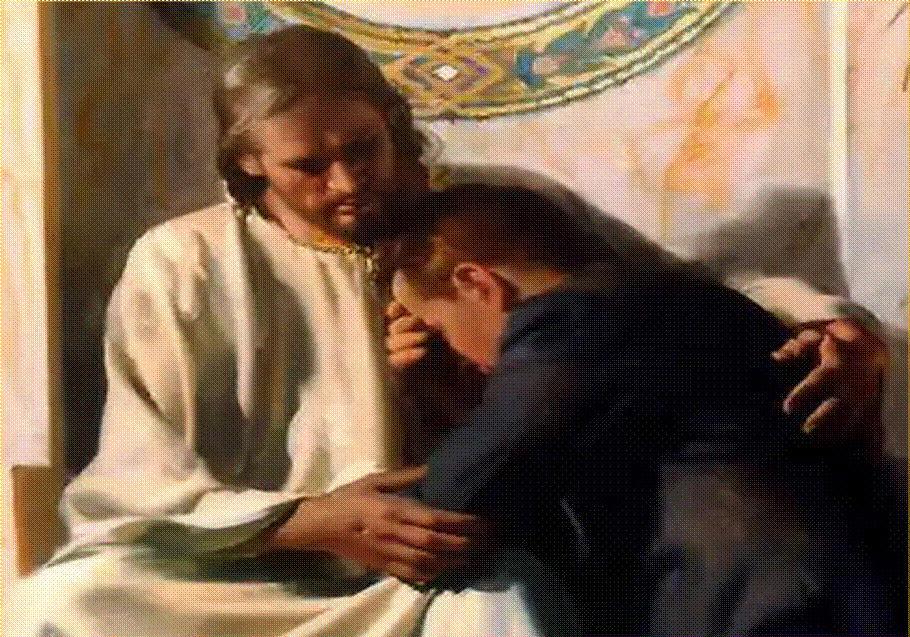
Confession is thus an encounter with the Lord:
Father Mallmann discusses the fruits of confession according to the teachings of Pope Pius XII:
Firstly, it increases true self-knowledge. The more specific the confession, the more firm will be the resolution;
Secondly, it encourages humility: “Since each of my failing’s spring, without a shadow of a doubt, from an upsurge of pride [my ego] which prefers my will to the will of God, is it not natural that my pride be curtailed principally by the humiliation that comes with true confession of my sin?”;
Thirdly, confession lends itself to the uprooting of bad habits;
Fourthly, we will combat spiritual negligence and lukewarmness: “My love for Jesus will be renewed, and having rediscovered the fear of sin, the Passion and the Cross will once more take on their true dimensions and I will be astonished by the bounty, patience and mercy of God.”;
Fifthly, confession purifies our conscience. The more we confess, the less likely are we to be deceived about the state of our soul;
Sixthly, confession strengthens the will not to sin;
Seventhly, it lends itself to spiritual direction. St Bernard said: “He who would be a teacher to himself is student to a fool!”;
Finally, confession increases grace in our lives.
Father Thwaites notes three qualities of a good confession:
First, exactness: We should distinguish between what is sinful and what is just an imperfection. We are there to confess our sins, not those of others.
Secondly, tranquility: “Too much anxiety can diminish our confidence in God’s love for us, so we should have great peace in this sacrament.
Thirdly, quality is energy, and this refers to our purpose of amendment. Our desire to correct our faults.
I will end this reflection with these beautiful words of Father Thwaites:
“In conclusion, we must try to have a great love of this sacrament. When Jesus came back from the dead, He could hardly wait to give (this sacrament) to us. He had hardly got into the upper room before He was saying: Receive the Holy Spirit, whose sins you forgive, they will be forgiven. That is what He came into the world for, to forgive us our sins. . .“
REFERENCES
- J. H Vander Veldt and R Odenwald, Psychiatry and Catholicism (McGraw-Hill, 1952)
- J. de Mallmann Un Resourcement Permanent La Confession (H. BOSCQ, 1988)
- Fr. Hugh Thwaites, S.J. Confession (Augustine Publishing Co, 1985)
______________________________
NOTE: A BRIEF HISTORY ABOUT THE CATHOLIC CHURCH’S UNDERSTANDING OF THE SACRAMENT OF CONFESSION:
1 Corinthians was written by the Apostle Paul around 53–56 AD(most commonly cited as spring AD 55 or 56). It was written from Ephesus during his third missionary journey to address divisions and immoral behavior in the Corinthian church.: “Whoever . . . eats the bread or drinks the cup of the Lord in an unworthy manner will be guilty of profaning the body and blood of the Lord” (1 Cor. 11:27).
The Lapsed 15:1–3 (A.D. 251) states “Of how much greater faith and salutary fear are they who . . . confess their sins to the priests of God in a straightforward manner and in sorrow, making an open declaration of conscience. . . . I beseech you, brethren, let everyone who has sinned confess his sin while he is still in this world, while his confession is still admissible, while the satisfaction and remission made through the priests are still pleasing before the Lord”.
Letters 9:2, 1 Cor. 11:27 (A.D. 253) states “Whosoever shall eat the bread and drink the cup of the Lord unworthily, shall be guilty of the body and blood of the Lord.”
Treatises 7:3 (A.D. 340) states “And if anyone uncovers his wound before you, give him the remedy of repentance. And he that is ashamed to make known his weakness, encourage him so that he will not hide it from you. And when he has revealed it to you, do not make it public, lest because of it the innocent might be reckoned as guilty by our enemies and by those who hate us.”
Saint Basil the Great (Rules Briefly Treated 288) (A.D. 374) states “It is necessary to confess our sins to those to whom the dispensation of God’s mysteries is entrusted. Those doing penance of old are found to have done it before the saints. It is written in the Gospel that they confessed their sins to John the Baptist (Matt. 3:6), but in Acts (19:18) they confessed to the apostles.”
Saint John Chrysostom (The Priesthood 3:5) (A.D. 387) states “Priests have received a power which God has given neither to angels nor to archangels. It was said to them: ‘Whatsoever you shall bind on earth shall be bound in heaven; and whatsoever you shall loose, shall be loosed.’ Temporal rulers have indeed the power of binding; but they can only bind the body. Priests, in contrast, can bind with a bond which pertains to the soul itself and transcends the very heavens. Did [God] not give them all the powers of heaven? ‘Whose sins you shall forgive,’ he says, ‘they are forgiven them; whose sins you shall retain, they are retained.’ What greater power is there than this? The Father has given all judgment to the Son. And now I see the Son placing all this power in the hands of men [Matt. 10:40; John 20:21–23].”
Saint Ambrose of Milan (Penance 1:1) (A.D. 388) states “For those to whom [the right of binding and loosing] has been given, it is plain that either both are allowed, or it is clear that neither is allowed. Both are allowed to the Church, neither is allowed to heresy. For this right has been granted to priests only.”
Saint Jerome (Commentary on Ecclesiastes 10:11) (A.D. 388) states “If the serpent, the devil, bites someone secretly, he infects that person with the venom of sin. And if the one who has been bitten keeps silence and does not do penance and does not want to confess his wound . . . then his brother and his master, who have the word [of absolution] that will cure him, cannot very well assist him”
Finally, a Pope speaks out. Pope Innocent III mandated, in 1215, that Catholics receive communion at least once a year, ideally in the Easter season, and confess grave sins at least once a year. These mandates remain in effect today under canon law.
In the early twentieth century Pope Pius X stressed the benefits for Catholics of regular communion and confession, and “he also thought that this should begin at age seven, when children reach the age of reason.
For your spiritual help and well-being, Dan Steele